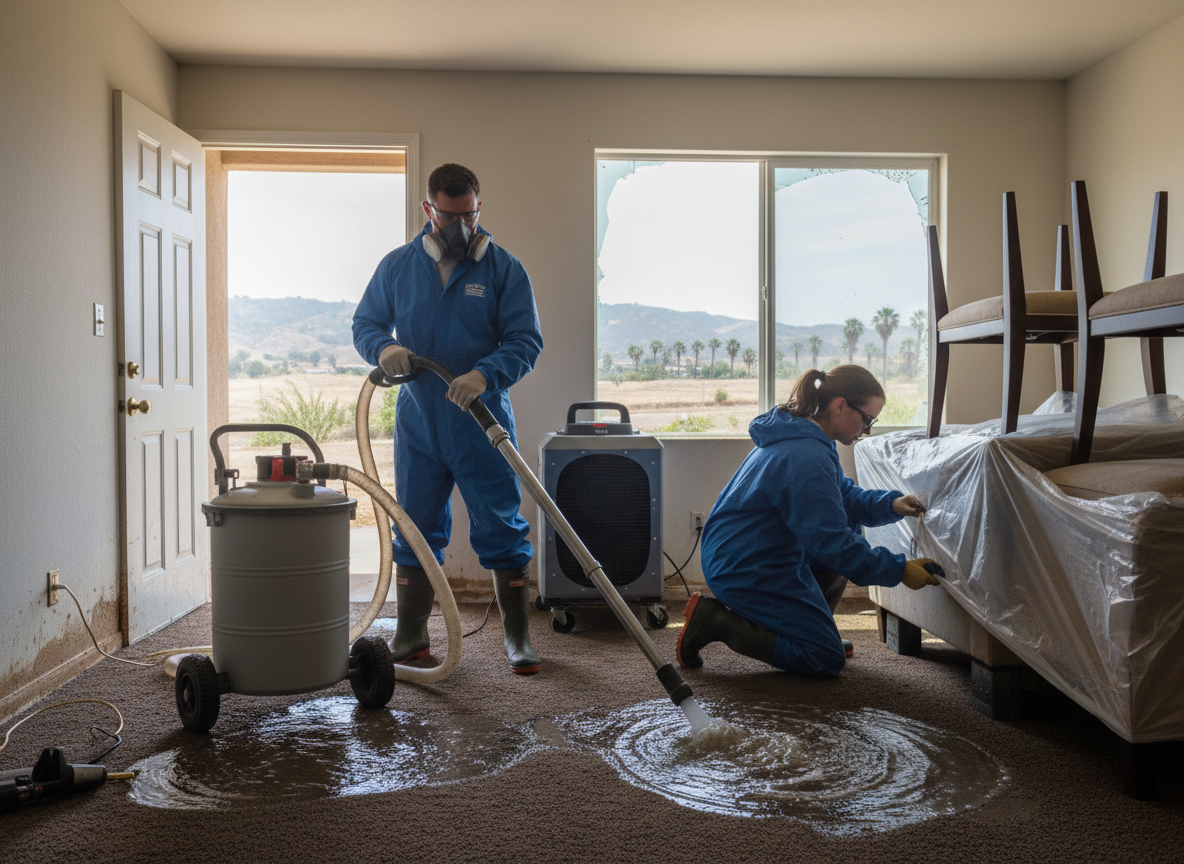
Midway City sits in Orange County where older single-family homes from the 1950s and 1960s often have slab foundations and older plumbing that fails without warning. When a supply line bursts under a kitchen or bathroom, water spreads quickly beneath the slab and into adjacent walls. Emergency water removal crews must locate the hidden path of moisture before mold sets in, especially during the warm, humid months when evaporation slows drying. Technicians use moisture meters and infrared cameras to map saturation in the concrete and framing without unnecessary demolition.
California building codes require proper ventilation and moisture barriers in crawl spaces, yet many Midway City properties still lack updated systems. After heavy winter rains or an overflowing washer, standing water can reach electrical outlets and HVAC returns within hours. Extraction equipment must be staged to pull water while protecting circuits, and crews often coordinate with electricians to isolate power before starting. Failure to address sub-slab moisture leads to recurring musty odors and warped flooring that only appears weeks later.
Terrain in the area is flat, so water does not drain away naturally from foundations. When a water heater leaks or a roof valley fails during rare but intense downpours, the liquid pools against stucco walls and seeps inward. Portable extractors and air movers are positioned to create directed airflow across carpet pads and hardwood, while dehumidifiers run continuously to drop indoor humidity below 50 percent. Homeowners who attempt DIY removal with shop vacs usually miss the pad beneath the carpet, leaving hidden moisture that damages baseboards and drywall.
Response time matters because drywall begins to delaminate after 24 to 48 hours of saturation. Crews arriving from the Beach Boulevard location can reach most Midway City addresses within 30 minutes at any hour. They document moisture levels at the start and end of each visit so insurance adjusters see the actual extent of water migration through the structure.
Technician insight
In California, the thing that catches most people out with emergency water removal is how fast moisture travels under the slab in Midway City homes built before 1970. Flat lots and older plumbing mean water spreads sideways instead of draining away, so you have to pull the carpet pad and run equipment longer than most homeowners expect or the drywall will still read wet two weeks later.
Slab Leak Under 1960s Kitchen
A supply line failed beneath the slab in a Midway City home, sending water under the linoleum and into the adjacent hallway wall. Meters showed saturation extending four feet beyond the visible wet area. Extraction removed standing water, then drying equipment ran for five days until readings matched unaffected rooms.
How it works
- 1
Arrival and Safety Assessment
Technician arrives, shuts off water source if still active, and checks for electrical hazards before any extraction begins.
- 2
Water Extraction
Industrial vacuums and pumps remove standing water from floors, carpets, and affected cavities.
- 3
Moisture Mapping
Infrared and pin meters locate hidden saturation in walls, subfloors, and slab edges.
- 4
Drying and Monitoring
Air movers and dehumidifiers are placed; daily readings track progress until levels return to normal.
Pricing
Upfront quotes given after inspection; final cost depends on volume of water, affected square footage, and drying duration.